Introduction: The Question Every Man Asks But Rarely Out Loud
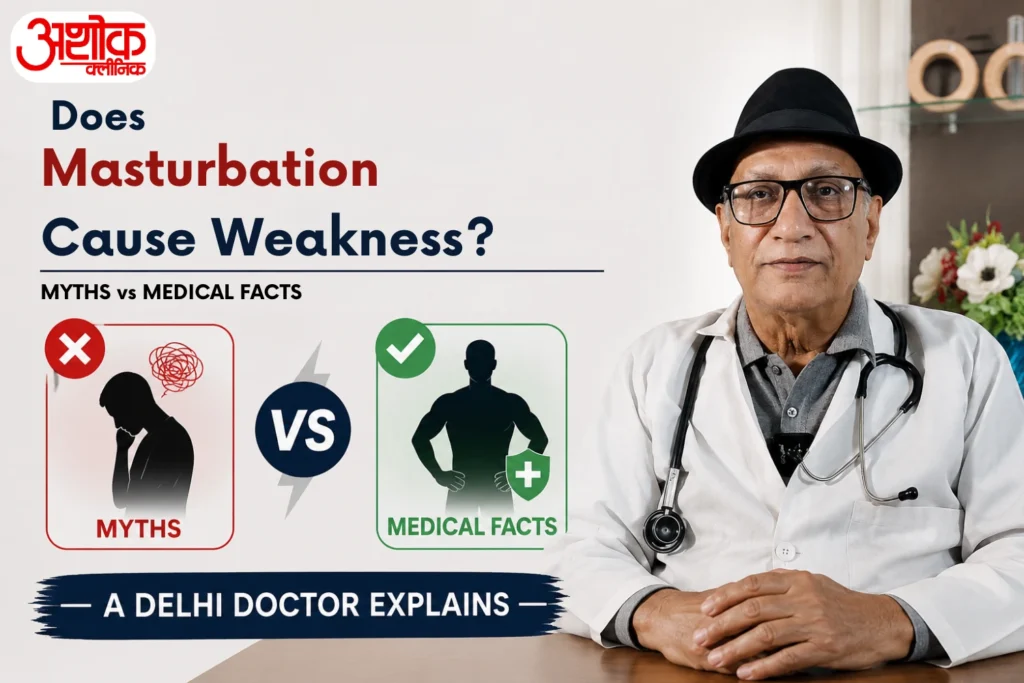
“Doctor, does masturbation cause weakness?“
In over 50 years of practice as a sexologist in Pitampura, this is one of the most frequently asked questions I hear — whispered across my consultation desk, typed into a search bar at midnight, or finally voiced after months of silent worry. It is a question rooted in genuine concern, cultural conditioning, and a lack of straightforward medical information.
So today, I — Dr. Ashok Gupta, a practising sexologist in Delhi at Ashok Clinic in Pitampura — am going to answer it honestly, clearly, and without judgment.
The short answer? No, masturbation does not cause weakness in healthy men. But there is a longer, more nuanced story here — one that addresses why this belief exists, what the science actually says, and when masturbation can become a concern worth discussing with a doctor.
Let’s separate fact from fiction.
Why Do So Many Indian Men Believe Masturbation Causes Weakness?
The belief that masturbation causes weakness is not new. It has been passed down through generations, reinforced by cultural narratives, old Ayurvedic misinterpretations, and social taboo. Here are the three main reasons this myth persists in India:
1. The “Semen Is Vital Energy” Belief Traditional texts, when misread or taken out of context, suggest that semen represents ojas — a form of vital life energy. The belief that losing semen depletes this energy has led many men to fear any form of ejaculation outside of procreation.
2. Lack of Open Sexual Health Education India’s school curriculum still does not include comprehensive sexual health education. Boys grow up learning about sexuality through peers, unreliable internet sources, or cultural stories — none of which are medically accurate.
3. Generalised Guilt and Anxiety Many men who masturbate frequently feel post-orgasm fatigue or mood dips. This is a normal, temporary physiological response — not permanent weakness. But without proper guidance, this normal experience gets interpreted as damage.
At Ashok Clinic in Pitampura, we see the consequences of these myths every week — men who have spent years blaming masturbation for tiredness, focus issues, or relationship problems, when the real causes are entirely different.
Does Masturbation Cause Weakness? What Medical Science Says
Let us be direct: medical science does not support the claim that masturbation causes physical weakness, organ damage, infertility, or loss of eyesight.
Here is what research and clinical medicine actually tells us:
✅ Masturbation Is a Normal Sexual Behaviour
The American Urological Association, World Health Organization, and every major medical body worldwide classify masturbation as a normal part of human sexuality at all life stages. It is practised by the vast majority of men across all cultures.
✅ Semen Production Is Continuous
Your body produces sperm and semen on an ongoing basis. Ejaculating — whether through masturbation or intercourse — does not permanently deplete your reserves. Within 24–72 hours, sperm and seminal fluid replenish naturally. There is no “running out.”
✅ No Evidence of Physical Weakness
Multiple clinical studies have found no causal link between masturbation frequency and muscle weakness, physical fatigue, memory loss, poor concentration, or reduced testosterone levels in the long term. The post-orgasm tiredness some men experience is caused by a temporary release of prolactin and oxytocin — hormones that normalise within 20–30 minutes.
✅ It Can Actually Have Health Benefits
Moderate masturbation has been associated with:
- Reduced risk of prostate issues in some studies
- Stress and anxiety relief
- Better understanding of one’s own body and sexual responses
- Improved sleep quality due to post-orgasm relaxation
⚠️ The Exception: When It Becomes Compulsive
The only scenario where masturbation becomes a genuine medical concern is when it turns compulsive — meaning it interferes with daily life, relationships, work, or mental health. This is classified as hypersexuality or compulsive sexual behaviour, and it is treatable. We handle such cases regularly at Ashok Clinic in Pitampura.
10 Common Myths About Masturbation — Debunked by Dr. Ashok Gupta
Myth 1: “Masturbation causes hair fall”
Fact: Hair fall is caused by genetics, hormonal imbalance (especially DHT), nutritional deficiencies, or scalp conditions — not masturbation. There is no physiological connection between ejaculation and hair loss.
Myth 2: “It reduces testosterone levels permanently”
Fact: Testosterone may show a brief, minor fluctuation post-ejaculation but returns to baseline levels quickly. No peer-reviewed study has demonstrated permanent testosterone reduction from masturbation.
Myth 3: “It causes erectile dysfunction (ED)”
Fact: Masturbation itself does not cause ED. However, if someone regularly uses very high-stimulation pornography alongside masturbation and then struggles to perform with a real partner, that is a psychological/behavioural issue — not a physical one caused by the act itself. As a Dr. Ashok Gupta sexologist in Delhi, I treat this distinction carefully with each patient.
Myth 4: “It weakens the spine or back”
Fact: There is no anatomical or neurological evidence connecting masturbation to spinal weakness or back pain. If you experience back pain, the causes are postural, muscular, or structural — completely unrelated.
Myth 5: “It makes you infertile”
Fact: Masturbation does not damage sperm quality or reduce fertility in men with normal reproductive health. In fact, regular ejaculation can prevent sperm from becoming stale in the ducts, which can slightly improve sperm quality.
Myth 6: “It causes memory loss and poor concentration”
Fact: There is no neurological mechanism through which masturbation impairs memory or cognition. If you are experiencing memory issues or inability to concentrate, the likely causes are sleep deprivation, stress, anxiety, or nutritional gaps.
Myth 7: “It stunts physical growth in teenagers”
Fact: Puberty and physical growth are governed by growth hormone and genetic factors — completely independent of sexual activity or masturbation.
Myth 8: “Frequent masturbation shrinks the penis”
Fact: This is anatomically impossible. Penile size is determined by genetics and development during puberty — not affected by masturbation frequency.
Myth 9: “It causes skin problems like acne”
Fact: Acne is caused by hormonal fluctuations (especially during puberty), excess sebum production, and bacterial activity on skin. Masturbation plays no direct role.
Myth 10: “Once you start, you can never stop — it becomes an addiction”
Fact: Most people who masturbate do so moderately and without any compulsive pattern. While hypersexuality is a real condition, it affects a small percentage of people and is caused by deeper psychological factors — not masturbation itself.
When Should You Actually Be Concerned?
While masturbation is generally harmless, there are genuine scenarios where speaking to a sexologist in Pitampura makes sense:
1. When it has become compulsive If you find yourself unable to control the urge to masturbate, it is affecting your work, relationships, or social life, or you feel distressed about it — speak to a doctor. This is treatable.
2. When it is accompanied by pain Pain during or after masturbation can indicate a structural issue, skin condition, or infection that requires medical attention.
3. When it is replacing intimacy with a partner If masturbation is significantly reducing your desire or ability to be intimate with your partner, that may need to be explored — both medically and through counselling.
4. When you notice blood in semen Haematospermia (blood in semen) should always be evaluated by a doctor regardless of the cause.
5. When performance anxiety has developed Some men develop performance anxiety after comparing themselves to unrealistic portrayals in pornography. Dr. Ashok Gupta sexologist in Delhi regularly helps men work through this with a combination of counselling and, where needed, Ayurvedic support for anxiety and confidence.
What Dr. Ashok Gupta Recommends
After more than five decades of clinical experience at Ashok Clinic in Pitampura, here is my simple guidance:
If you masturbate occasionally and it does not affect your life — there is nothing to worry about. Your body is functioning normally.
If you feel persistent fatigue, weakness, low libido, or erectile difficulties — do not automatically blame masturbation. These symptoms have real, treatable medical causes: low testosterone, thyroid issues, vitamin D deficiency, sleep disorders, diabetes, or psychological stress. A proper clinical evaluation will identify the real cause.
If you feel guilt or shame about masturbation — I encourage you to let that go. Shame is not a medical diagnosis. It is a cultural inheritance. Your health matters more than an outdated belief.
And if anything continues to bother you — physical, emotional, or relational — my door at Ashok Clinic in Pitampura is always open.
📞 Book a Confidential Consultation at Ashok Clinic
Concerned about sexual health, weakness, low energy, or performance issues? Speak directly with Dr. Ashok Gupta — trusted Sexologist in Pitampura with 50+ years of experience.
🏥 Ashok Clinic in Pitampura | Near Pitampura Metro Station, Pillar No. 365, Delhi – 110034 📞 Call / WhatsApp: +91 98110-92140 🕐 Timings: Mon–Fri: 11 AM–5 PM | Sat: 10:30 AM–5:30 PM 🌐 Website: www.ashokclinic.in
All consultations are 100% private and confidential.
Frequently Asked Questions (FAQs)
No. Medical science does not support this claim. Masturbation does not cause physical weakness, organ damage, or loss of vitality in healthy men. The temporary fatigue some men feel after orgasm is a normal hormonal response that resolves within 30 minutes. If you are experiencing persistent weakness, it is worth investigating other causes such as low testosterone, anaemia, or poor sleep — a sexologist in Pitampura like Dr. Ashok Gupta can help identify the real cause.
There is no universal "normal" frequency. It varies enormously from person to person and changes with age, relationship status, stress levels, and libido. What matters is whether it is causing you distress or interfering with your life — if not, it is within a healthy range. If you are unsure, a confidential consultation at Ashok Clinic in Pitampura can give you a personalised assessment.
Masturbation alone does not cause erectile dysfunction (ED). However, habitually using pornography during masturbation can, in some men, create unrealistic expectations and psychological performance anxiety with a real partner. This is not a physical condition caused by masturbation but a behavioural pattern that is fully treatable. Dr. Ashok Gupta, sexologist in Delhi, regularly helps men overcome this.
No. Masturbation does not permanently reduce sperm count or damage fertility in men with healthy reproductive systems. Sperm is continuously produced, and the body replenishes within 24–72 hours after ejaculation. If you have concerns about fertility, a semen analysis at Ashok Clinic in Pitampura can give you a clear picture.
Post-orgasm fatigue is a completely normal physiological response. After ejaculation, the brain releases prolactin (a relaxation hormone), serotonin, and oxytocin — all of which cause a feeling of drowsiness and calm. This typically resolves within 20–40 minutes. If the fatigue is extreme, lasts for days, or is accompanied by other symptoms like low mood or reduced libido, it may indicate an underlying issue worth investigating — not masturbation itself.
Yes. If you are experiencing genuine weakness, low energy, or reduced sexual vitality — Ayurvedic medicine offers highly effective, side-effect-free treatments. At Ashok Clinic in Pitampura, Dr. Ashok Gupta uses time-tested Ayurvedic formulations including Ashwagandha, Shilajit, and Safed Musli — personalised to your body type and condition — to restore energy, hormonal balance, and sexual confidence.
Absolutely. A qualified sexologist in Delhi like Dr. Ashok Gupta is trained to discuss all aspects of sexual health — including masturbation — without judgment or embarrassment. At Ashok Clinic in Pitampura, complete confidentiality is guaranteed. You will never be lectured or shamed — only helped.
Consider seeing a sexologist in Pitampura if: you feel the urge is compulsive and out of control; it is affecting your relationship, work, or sleep; you experience physical pain; it has led to performance anxiety; or you simply feel something is "not right" with your sexual health. Early consultation leads to faster, easier resolution.
🩺 Take the First Step — Your Health Deserves It
You searched for this answer because something is on your mind. Don’t let doubt, embarrassment, or old myths stop you from getting clarity.
Dr. Ashok Gupta at Ashok Clinic in Pitampura has helped over 50,000 men across Delhi reclaim their health, confidence, and peace of mind.
Book your confidential appointment today.
📞 +91 98110-92140 | 🌐 www.ashokclinic.in 📍 17, 1st Floor, DDA Rajasthali Market, Pitampura, Delhi – 110034
Disclaimer: This article is written for informational purposes by Dr. Ashok Gupta, Sexologist in Pitampura at Ashok Clinic. It is not a substitute for personalised medical advice. Please consult a qualified doctor for any health concerns.