
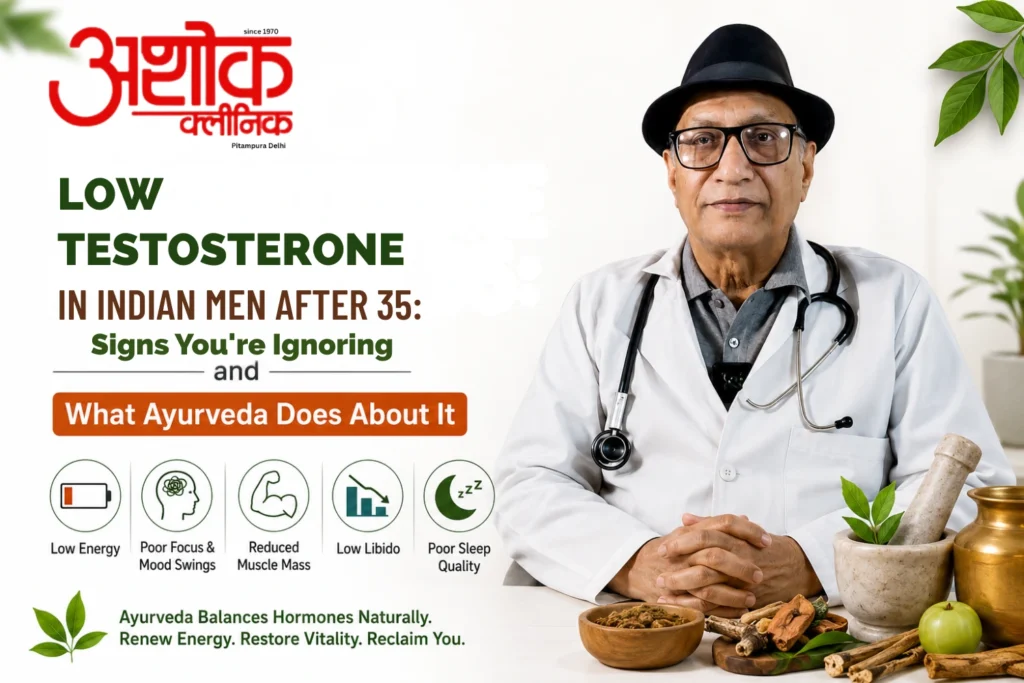
Low Testosterone in Indian Men After 35: Signs You're Ignoring and What Ayurveda Does About It
A 42-year-old marketing executive from Model Town came to Ashok Clinic last winter. He was not there for a sexual health problem — or so he thought.
He had come because he was exhausted. Bone-tired at 3 PM every day, despite sleeping eight hours. His gym performance had been declining for over a year. He had put on weight around the abdomen despite not eating more. His temper was shorter. His drive — for work, for intimacy, for the things he used to love — had quietly flattened.
“I thought I was just getting older,” he told me. “I thought this was what 42 was supposed to feel like.”
His blood tests told a different story. His total testosterone was 241 ng/dL. At his age, it should have been between 400 and 700. He was not “getting older.” He had clinically significant low testosterone — a condition affecting millions of Indian men who, just like him, never suspect it is the reason they feel the way they do.
In 50 years of practice as a sexologist in Delhi, I have seen low testosterone misdiagnosed as depression, overwork, midlife crisis, vitamin deficiency, and simply “getting old.” It is one of the most under-recognised conditions in Indian men’s health — and one of the most treatable.
This blog is a complete clinical guide to low testosterone symptoms in India, what causes it, when it becomes andropause, and exactly how Ayurveda treats it at Ashok Clinic.
What Is Testosterone and Why Does It Matter So Much?
Testosterone is the primary male sex hormone, produced mainly in the testes under instruction from the brain’s pituitary gland. It does far more than drive sexual desire. Testosterone is responsible for:
- Muscle mass and physical strength — it drives protein synthesis and muscle recovery
- Bone density — low testosterone accelerates bone loss in men, a fact almost no one discusses
- Fat distribution — testosterone helps prevent abdominal fat accumulation
- Energy and motivation — testosterone directly influences the brain’s dopamine and motivation pathways
- Mood and mental clarity — low testosterone is associated with irritability, depression, and brain fog
- Red blood cell production — testosterone stimulates erythropoietin, which affects energy and stamina
- Sexual function — libido, erectile quality, and ejaculatory health are all testosterone-dependent
- Sperm production — intratesticular testosterone is essential for spermatogenesis
After the age of 30, men’s testosterone levels decline at approximately 1–2% per year. This is normal. What is not normal — but has become alarmingly common — is the rate at which Indian men are experiencing accelerated testosterone decline due to chronic stress, lifestyle factors, environmental toxins, and unmanaged metabolic conditions.
When this decline reaches a point where it produces symptoms and measurable hormonal deficiency, the condition is called andropause — or male menopause in India, as it is increasingly referred to in patient conversations.
The Andropause Reality: Why Indian Men Are Being Hit Harder
Andropause — the gradual hormonal decline in ageing men — is a global phenomenon. But Indian men face a uniquely challenging set of risk factors that accelerate testosterone decline beyond what age alone explains:
Chronic stress and cortisol overload. Cortisol — the stress hormone — directly suppresses testosterone production. Indian men in urban centres like Delhi, Mumbai, and Bengaluru operate under relentless occupational, financial, and family pressure. High cortisol, sustained over years, becomes one of the most powerful testosterone suppressors there is.
Metabolic syndrome and insulin resistance. India has the second-highest diabetic population in the world. Insulin resistance and excess abdominal fat create an enzyme called aromatase, which converts testosterone into oestrogen — directly lowering free testosterone levels.
Poor sleep quality. The majority of testosterone is produced during deep sleep (particularly REM and stage 3 NREM). India’s urban sleep crisis — late nights, screen exposure, stress-driven insomnia — directly reduces testosterone production night after night.
Environmental endocrine disruptors. Plastics, pesticides, industrial chemicals, and Delhi’s severe air pollution all contain compounds that mimic oestrogen in the body, suppressing testosterone at a cellular level.
Sedentary lifestyles. Physical activity — particularly resistance training — is one of the most powerful natural testosterone stimulants. As sedentary desk-based work becomes the norm, this natural boost disappears.
The result: men in their mid-30s and 40s presenting with low testosterone symptoms in India that would not have been expected until their late 50s or 60s in previous generations.
12 Signs of Low Testosterone Indian Men Most Often Ignore
This is the section I want every man to read carefully. Low testosterone does not arrive with a clear announcement. It accumulates quietly, sign by sign, until the cumulative picture reveals it — usually years after it began.
1. Persistent, Unexplained Fatigue
Not tiredness that sleep fixes. A deep, systemic fatigue that is present even after a full night’s rest. Men often attribute this to work stress or poor diet. It is frequently testosterone deficiency.
2. Declining Libido — The Drive That Used to Be There
A gradually fading interest in sex is one of the earliest and most reliable signs of low testosterone. This is not occasional disinterest. It is a consistent, noticeable reduction in spontaneous sexual desire — the kind that used to be taken for granted.
3. Erectile Dysfunction — Particularly Reduced Morning Erections
Testosterone is not the only factor in erections, but it is a critical one. Reduced morning erections and difficulty achieving full firmness are often early indicators of falling testosterone. Many men in their late 30s and 40s who present at Ashok Clinic for erectile dysfunction are actually experiencing low testosterone as the primary driver.
4. Loss of Muscle Mass Despite Exercise
If your gym performance has plateaued or declined — if recovery takes longer, if muscle gain has become harder despite consistent training — low testosterone is a very likely reason. Testosterone is the primary anabolic hormone that drives muscle protein synthesis.
5. Abdominal Weight Gain That Won’t Shift
Visceral fat — the fat that accumulates around the belly — is both a cause and a consequence of low testosterone. As testosterone drops, abdominal fat increases. As abdominal fat increases, aromatase activity rises, converting more testosterone to oestrogen, which drives more fat accumulation. It is a cycle that diet alone cannot break.
6. Mood Changes — Irritability, Depression, and Flat Affect
Testosterone has a profound effect on brain chemistry. Low levels are associated with increased irritability, reduced patience, heightened anxiety, and a pervasive flatness of mood — a loss of enthusiasm and enjoyment that men often describe as “not feeling like myself.” This is frequently misdiagnosed as clinical depression and treated with antidepressants that may further suppress testosterone.
7. Brain Fog and Declining Mental Sharpness
Difficulty concentrating, slower recall, reduced mental clarity — testosterone plays a significant neuroprotective and cognitive role. Men with low testosterone consistently report feeling mentally “duller” than they used to be.
8. Reduced Body and Facial Hair
Testosterone governs hair growth in men. Thinning body hair, reduced facial hair growth, or changes in hair pattern can be subtle signs of testosterone decline.
9. Sleep Disturbances
Low testosterone disrupts sleep architecture, particularly reducing deep sleep stages. Ironically, poor sleep further suppresses testosterone production — creating a cycle of hormonal decline and sleep disruption that reinforces itself.
10. Reduced Bone Density — The Silent Sign
Testosterone is essential for maintaining bone mineral density in men. Long-term low testosterone increases the risk of osteoporosis and stress fractures — a condition most Indian men never associate with their hormone levels.
11. Shrinking Testicular Size
A gradual reduction in testicular volume can occur with prolonged low testosterone. This is often not noticed or is dismissed as irrelevant by men who are unaware of its clinical significance.
12. Hot Flushes and Night Sweats
Yes — men get these too. Sudden warmth, flushing, and night sweats are recognised symptoms of andropause in men, directly paralleling menopause in women. They are almost never discussed and frequently go unrecognised.
When Does Low Testosterone Become Andropause?
Andropause — also called Late-Onset Hypogonadism (LOH) — is the clinical term for symptomatic testosterone deficiency in middle-aged and older men. It is distinguished from normal age-related testosterone decline by:
- Measurable hormonal deficiency on blood testing (typically total testosterone below 300 ng/dL)
- Presence of multiple symptoms from the list above
- Significant impact on quality of life, relationship health, or work performance
Unlike female menopause, which happens over a few years, male menopause in India unfolds gradually over a decade or more — which is precisely why it goes unrecognised for so long. There is no single moment of change. There is only the slow accumulation of a life that no longer feels quite right.
Diagnosing Low Testosterone: What We Test at Ashok Clinic
Before any treatment, proper diagnosis is essential. At Ashok Clinic, a complete testosterone evaluation includes:
Total Testosterone — the baseline measurement. We typically test in the morning (7–10 AM) when levels are naturally highest.
Free Testosterone — only a fraction of total testosterone is biologically active. Free testosterone levels can be low even when total testosterone appears borderline normal.
LH and FSH — pituitary hormones that regulate testosterone production. Their levels tell us whether the problem originates in the brain or the testes.
Prolactin — elevated prolactin suppresses testosterone and is a frequently missed cause of andropause-like symptoms.
Thyroid panel (TSH, T3, T4) — thyroid disorders mimic low testosterone and must be excluded.
Blood sugar and insulin resistance markers — critical given India’s high metabolic disease burden.
Lipid profile — cardiovascular risk assessment that informs treatment approach.
This comprehensive evaluation, conducted under Dr. Rahul Gupta (MBBS) at Ashok Clinic, ensures that every treatment plan is built on an accurate diagnosis — not assumptions.
Testosterone Deficiency Treatment Delhi — The Ashok Clinic Approach
At Ashok Clinic, our treatment for low testosterone combines Ayurvedic rejuvenation therapy with medical management where required. Our approach is integrative, personalised, and built around the full picture of each patient — not just their test results.
✅ Ayurvedic Treatment for Low Testosterone
Ayurveda approaches low testosterone as a disorder of Shukra Dhatu (reproductive tissue) and Ojas (vital essence) — driven by excess Vata or Pitta, depleted by chronic stress, poor sleep, and inadequate nourishment of the reproductive system. The goal of Ayurvedic andropause treatment is not to replace testosterone synthetically but to restore the body’s natural capacity to produce it.
Ashwagandha (Withania somnifera) — The Cornerstone Testosterone Booster Ashwagandha is the most clinically validated Ayurvedic testosterone booster in existence. A landmark double-blind study found that men taking standardised Ashwagandha extract for 8 weeks experienced a 14.7% increase in testosterone alongside a 27.9% reduction in cortisol. At Ashok Clinic, it is the first herb we reach for in stress-driven andropause — because it simultaneously addresses the cortisol overload that is suppressing testosterone and directly supports its production.
Shilajit — The Mitochondrial Testosterone Restorer Purified Shilajit is rich in fulvic acid and over 84 trace minerals, including zinc — the single most important mineral for testosterone synthesis. A clinical trial in Andrologia demonstrated a significant increase in total and free testosterone in men taking Shilajit for 90 days. Shilajit works particularly well for men experiencing both fatigue and hormonal decline — it restores energy at the mitochondrial level while supporting testosterone production simultaneously.
Gokshura (Tribulus terrestris) Gokshura stimulates the pituitary’s production of LH (luteinising hormone), which in turn signals the testes to produce more testosterone. It is particularly effective for men whose LH levels are suboptimally low — a pattern commonly seen in stress-related andropause.
Kaunch Beej (Mucuna pruriens) Kaunch Beej raises dopamine levels via its natural L-DOPA content, which stimulates the hypothalamus to release GnRH — the upstream hormone that initiates the testosterone production cascade. It is one of the most targeted herbal interventions for hormonal axis support in Ayurveda.
Shatavari and Bala (Sida cordifolia) These Rasayana herbs support Ojas — the Ayurvedic concept of vital vitality — rebuilding the deep physical and hormonal reserves that andropause depletes. They work best as part of a long-term rejuvenation protocol.
Every Ayurvedic prescription at Ashok Clinic is personalised. Your dosha, health history, lifestyle, blood test results, and specific symptom pattern all determine which herbs you receive, at what dose, and in what combination. There is no generic “testosterone formula” — there is your specific treatment plan.
✅ Lifestyle Protocol — Essential for Lasting Results
No herbal treatment produces lasting results without the lifestyle foundation. As part of every low testosterone treatment in Delhi at Ashok Clinic, we prescribe:
Sleep optimisation — since the majority of testosterone is produced during deep sleep, protecting sleep architecture is non-negotiable. We provide specific sleep hygiene guidance tailored to the patient’s schedule and lifestyle.
Resistance exercise — compound movements (squats, deadlifts, pressing exercises) trigger short-term testosterone surges and support long-term hormonal balance. We guide patients on appropriate exercise intensity without overtraining (which raises cortisol and suppresses testosterone).
Dietary correction — zinc-rich foods (pumpkin seeds, nuts, legumes), healthy fats (essential for steroid hormone synthesis), cruciferous vegetables (which modulate oestrogen metabolism), and elimination of processed foods and excess sugar.
Stress management — Pranayama, specific yoga asanas (particularly those that stimulate the pelvic and abdominal region), and practical stress-reduction strategies that reduce cortisol sustainably.
Environmental toxin reduction — practical guidance on reducing plasticiser, pesticide, and pollution exposure in Delhi’s urban environment.
✅ Allopathic Medical Management Where Needed
For men with confirmed severe testosterone deficiency — particularly those with total testosterone below 200 ng/dL or with co-existing metabolic conditions — Dr. Rahul Gupta (MBBS) at Ashok Clinic provides evidence-based medical co-management. This may include monitored hormonal support, treatment of co-existing conditions like diabetes or thyroid disorders that are driving testosterone decline, and close follow-up with repeat blood testing.
We are clear about one thing: testosterone replacement therapy (TRT) is not first-line treatment for most cases of andropause in India. It carries risks — including suppression of natural production and fertility — and should only be used when clearly indicated and carefully monitored. Our goal is always to restore the body’s natural capacity first.
How Long Does Testosterone Treatment Take to Work?
| Goal | Expected Timeline with Ayurvedic Protocol |
|---|---|
| Improved energy and sleep quality | 3–4 weeks |
| Mood improvement and reduced irritability | 4–6 weeks |
| Libido and sexual desire restoration | 5–8 weeks |
| Measurable testosterone increase (blood test) | 8–12 weeks |
| Muscle recovery and body composition change | 10–16 weeks |
| Bone and systemic vitality restoration | 4–6 months |
These are averages based on clinical experience at Ashok Clinic. Results depend on severity of deficiency, consistency of treatment, lifestyle adherence, and whether co-existing conditions are being managed.
Why Ashok Clinic for Testosterone Deficiency Treatment in Delhi
Men come to us from Rohini, Shalimar Bagh, Punjabi Bagh, Model Town, Ashok Vihar, and across North Delhi searching for reliable testosterone deficiency treatment in Delhi. Here is what they find:
- 50+ years of clinical expertise in male hormonal health under Dr. Ashok Gupta
- Full diagnostic workup — we test before we treat
- Integrated Ayurvedic and allopathic care under one roof — Dr. Ashok Gupta and Dr. Rahul Gupta (MBBS)
- Personalised protocols — no off-the-shelf testosterone formulas
- Complete confidentiality — your records, your visit, and your diagnosis stay private
- Honest expectations — we tell you what is possible, what takes time, and what requires lifestyle change
📞 Book Your Testosterone Assessment Today
If you recognise yourself in the signs described above — the fatigue, the fading drive, the weight that won’t shift, the mood that isn’t quite yours anymore — do not dismiss it as ageing.
Have your testosterone tested. Know your numbers. And if they are low, know that there is a clear, safe, proven path to restoring them.
At Ashok Clinic, Pitampura, your first consultation is completely private, unhurried, and without judgement. We will evaluate your symptoms, run the right tests, and build a personalised treatment plan that addresses your specific situation.
📞 Call: +91 98110-92140 🕐 Mon–Fri: 11:00 AM – 5:00 PM | Saturday: 10:30 AM – 5:30 PM 📍 17, 1st Floor, DDA Rajasthali Market, Pitampura, near Metro Station Pillar No. 365, Delhi – 110034
Frequently Asked Questions — Low Testosterone & Andropause Treatment in Delhi
Normal total testosterone for adult men is generally considered to be between 300 and 1,000 ng/dL, with most healthy men in the 400–700 ng/dL range. After 35, a natural decline of 1–2% per year is expected. However, many Indian men are presenting with levels in the 200–300 ng/dL range in their late 30s and early 40s due to accelerated decline from stress, metabolic issues, and lifestyle factors. At Ashok Clinic, we evaluate not just total testosterone but free testosterone and associated hormones (LH, FSH, prolactin) for a complete hormonal picture. A number alone does not diagnose andropause — symptoms must be present alongside low levels for a clinical diagnosis.
Yes — multiple published clinical studies support Ayurvedic herbs for testosterone. Ashwagandha has shown 14–40% increases in testosterone in different trials. Shilajit has demonstrated significant increases in free and total testosterone in a 90-day randomised trial. Gokshura supports LH production, which drives natural testosterone synthesis. The key difference between Ayurvedic and synthetic testosterone therapy is that Ayurveda works by restoring the body's own hormonal production — rather than replacing it externally. This means results are more sustainable, there is no suppression of natural production, and fertility is maintained. At Ashok Clinic, these herbs are prescribed in clinically meaningful doses after a proper evaluation — not as generic over-the-counter supplements.
Andropause — clinically called Late-Onset Hypogonadism — is a recognised medical condition, distinct from normal ageing. Normal testosterone decline is gradual and produces minimal symptoms. Andropause involves testosterone levels falling below the clinical threshold for normal function, producing a specific cluster of symptoms including fatigue, low libido, mood changes, muscle loss, erectile difficulties, and cognitive changes. The distinction matters because andropause is treatable, while "getting older" is not. Many men in their 40s and 50s are living with treatable hormonal deficiency under the assumption that their symptoms are simply age. A blood test and clinical evaluation at Ashok Clinic in Delhi can clarify this in a single appointment.
Absolutely — and it is more common than most men realise. While testosterone naturally declines with age, the rate of decline has accelerated significantly in younger generations. Chronic stress, poor sleep, sedentary lifestyles, processed food diets, and environmental toxin exposure are all driving testosterone decline in men in their mid-30s. At Ashok Clinic, we regularly see men in their 30s with testosterone levels typically seen in men two decades older. The good news: younger men with low testosterone respond very well to treatment, often achieving full hormonal restoration within 3–4 months of a proper Ayurvedic protocol and lifestyle correction. Age 37 is not too young for low testosterone — and it is absolutely the right time to address it.
This is a critically important question, and the answer depends entirely on the type of treatment. Synthetic testosterone replacement therapy (TRT) — injections, gels, or patches — suppresses the body's natural testosterone production and significantly reduces sperm count, sometimes to zero. This is why we do not recommend TRT as a first-line treatment for men who may still want children. Ayurvedic treatment for low testosterone works in the opposite direction — by stimulating the body's natural production pathway through herbs like Ashwagandha, Shilajit, Gokshura, and Kaunch Beej, it supports testosterone levels while maintaining or improving sperm production. At Ashok Clinic, every treatment plan considers the patient's fertility goals before recommending any hormonal intervention. This is one of the most important reasons to see a specialist before starting any testosterone treatment.
Have more questions about low testosterone, andropause, or men’s hormonal health? Call us at +91 98110-92140 or book a consultation online. We are open Mon–Sat and happy to help — completely privately.
Related Reading
- Shilajit Benefits for Men: What an Ayurvedic Doctor in Delhi Has Seen in 50 Years
- Erectile Dysfunction Treatment in Delhi — What 50 Years of Practice Has Taught Us
- Loss of Libido Treatment at Ashok Clinic
- Sexual Weakness Treatment at Ashok Clinic
- Best Sexologist in Delhi — Ashok Clinic
- Male Infertility and Low Sperm Count Treatment
© 2026 Ashok Clinic, Pitampura, Delhi. All rights reserved. Dr. Ashok Gupta — Senior Ayurvedic Sexologist | Dr. Rahul Gupta — MBBS, Allopathic Sexologist. Call: +91 98110-92140 | Email: realashokclinic@gmail.com