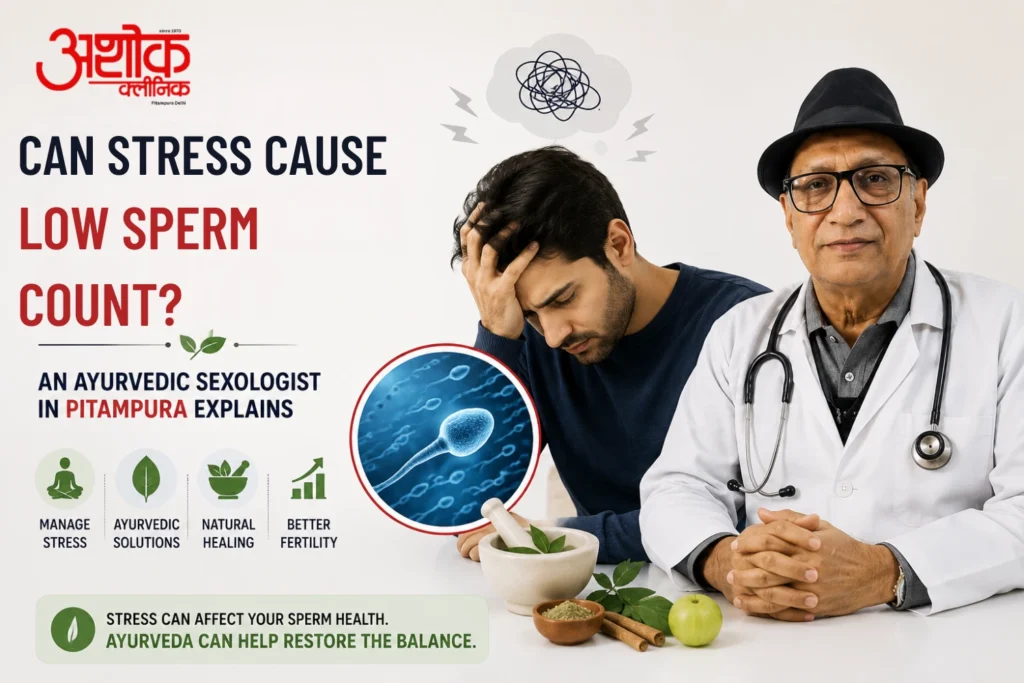
Can Stress Cause Low Sperm Count? An Ayurvedic Sexologist in Pitampura Explains
By Dr. Ashok Gupta | Senior Ayurvedic Sexologist, Ashok Clinic, Pitampura, Delhi Reviewed by Dr. Rahul Gupta | MBBS Allopathic Sexologist, Ashok Clinic
A 31-year-old man once walked into Ashok Clinic in Pitampura looking healthy, fit, and outwardly fine. He and his wife had been trying to conceive for over a year with no success. His semen analysis came back showing Low Sperm Count — medically known as oligospermia. No varicocele. No infection. No hormonal disorder detected on basic tests.
What had changed in the past 18 months? A startup he had been running was collapsing. He was sleeping four hours a night. He had not taken a single day off in over a year.
The culprit was chronic stress.
This is not an unusual case at Ashok Clinic. As a Sexologist in Pitampura with over 50 years of experience, Dr. Ashok Gupta has seen hundreds of men whose Low Sperm Count is directly linked to stress — and whose counts improved dramatically once the stress was treated alongside the underlying physical condition.
This blog explains exactly how stress affects sperm production, what Ayurveda says about it, and how men in Delhi are treating stress-related Low Sperm Count naturally and effectively.
What Is Low Sperm Count and Why Does It Matter?
Low Sperm Count (oligospermia) is defined as having fewer than 15 million sperm per millilitre of semen. A normal count ranges between 15 million and over 200 million per millilitre. The lower the count, the harder it is for sperm to reach and fertilise an egg.
Low Sperm Count is one of the leading causes of male infertility in India. Studies suggest that approximately 1 in 6 couples in India face fertility challenges, and male factors — including Low Sperm Count, poor sperm motility, and abnormal morphology — account for nearly 40 to 50% of those cases.
At Ashok Clinic, Dr. Ashok Gupta — a trusted Sexologist in Delhi — evaluates not just the sperm count itself but every possible root cause, including one that most men (and even many doctors) overlook: psychological and physiological stress.
How Does Stress Actually Cause Low Sperm Count? The Science Explained
Stress is not just a feeling. When you are under stress — whether from work pressure, relationship problems, financial worry, or sleep deprivation — your body activates the hypothalamic-pituitary-adrenal (HPA) axis and releases a surge of cortisol, your primary stress hormone.
Here is what that cortisol surge does to sperm:
1. It suppresses testosterone production. Cortisol and testosterone have an inverse relationship. When cortisol goes up, testosterone goes down. Since testosterone is the primary driver of sperm production in the testes, lower testosterone means fewer sperm — directly causing Low Sperm Count.
2. It disrupts the hormonal chain of sperm production. Sperm production depends on a precise hormonal sequence involving the brain, pituitary gland, and testes. Chronic stress disrupts the release of GnRH, LH, and FSH — the hormones that signal the testes to produce sperm. When this chain is interrupted, sperm production slows or stops.
3. It causes oxidative stress in the testes. Stress increases free radical production in the body. These free radicals damage sperm DNA, reduce sperm motility, and further decrease sperm count. Oxidative stress in the testes is one of the most scientifically established causes of Low Sperm Count in young men today.
4. It leads to behavioural changes that further hurt sperm. Men under stress often drink more alcohol, smoke more, sleep less, and eat poorly — all of which independently reduce sperm quality and count.
As a Sexologist in Pitampura, Dr. Ashok Gupta explains it simply to his patients: “Your brain and your testes are in constant conversation. When your brain is overwhelmed, the testes receive the signal to slow down. Stress is not just in your head — it is in your sperm count too.”
Types of Stress That Contribute to Low Sperm Count
Not all stress is the same. At Ashok Clinic, Dr. Ashok Gupta identifies three categories of stress that consistently show up in men with Low Sperm Count:
Chronic Psychological Stress — The Silent Sperm Killer
Long-term work pressure, marital conflict, anxiety, or depression sustained over months and years is the most damaging type. Unlike acute stress (which the body recovers from quickly), chronic stress keeps cortisol elevated continuously, causing sustained damage to hormone levels and sperm production.
Physical Stress — Overtraining and Sleep Deprivation
Overexercising without adequate recovery, chronic sleep deprivation (less than 6 hours per night), and physical illness all qualify as physical stressors that suppress testosterone and sperm production. This is seen especially in young men in Delhi who do intensive gym training without proper rest.
Heat Stress — Laptop, Tight Clothing, and Sedentary Jobs
The testes are located outside the body for a reason — sperm production requires a temperature approximately 2°C lower than core body temperature. Men who work long hours with laptops on their laps, wear very tight underwear, or sit for 8–10 hours daily without breaks expose their testes to excess heat — a physical stressor that directly reduces sperm count over time.
What Ayurveda Says About Stress and Low Sperm Count
Ayurveda understood the link between mental stress and male reproductive health thousands of years before modern medicine confirmed it scientifically.
In Ayurvedic science, sperm is governed by Shukra Dhatu — the seventh and most refined tissue in the body. Shukra Dhatu is produced through a series of progressive tissue refinements starting from the food you eat. Stress, in Ayurvedic terms, creates an imbalance of Vata dosha — the dosha associated with the nervous system, movement, and mental activity.
Elevated Vata from chronic stress disrupts the production and quality of Shukra Dhatu in two ways:
- It depletes Ojas — the vital essence that governs immunity, vitality, and reproductive strength. Men under heavy stress often report feeling exhausted, mentally foggy, and sexually disinterested — all signs of depleted Ojas.
- It overheats the system (aggravates Pitta) — which damages Shukra Dhatu quality, reducing sperm count, motility, and morphology.
Dr. Ashok Gupta at Ashok Clinic in Pitampura uses this Ayurvedic framework alongside modern diagnostic findings to create treatment plans that address both the stress and the Low Sperm Count simultaneously — rather than treating them as separate problems.
Ayurvedic Herbs Prescribed at Ashok Clinic for Stress-Related Low Sperm Count
These are the key Ayurvedic formulations that Dr. Ashok Gupta — the leading Sexologist in Pitampura — uses in the treatment of stress-related Low Sperm Count:
Ashwagandha (Withania Somnifera) — The Stress-Sperm Dual Solution
Ashwagandha is arguably the most researched Ayurvedic herb for both stress and male fertility. Clinical studies have found that men taking Ashwagandha showed significant reduction in cortisol and a measurable increase in sperm count, motility, and testosterone levels.
It works by reducing the HPA axis hyperactivation caused by chronic stress — directly addressing the hormonal pathway that links stress to Low Sperm Count.
Shilajit — Rebuilding Shukra Dhatu
Shilajit is a mineral-rich resin that Ayurveda classifies as a Rasayana — a substance that rebuilds and rejuvenates depleted body tissues. It has been shown in clinical research to increase total sperm count by up to 61% and sperm motility by 37% in men with Low Sperm Count.
At Ashok Clinic, Shilajit is prescribed in its purified form (Shuddha Shilajit) — not the adulterated versions commonly sold in the market.
Kapikachhu (Mucuna Pruriens) — Nature’s Dopamine Booster
Kapikachhu reduces cortisol while simultaneously increasing testosterone, LH, and sperm count. It also raises dopamine levels — directly counteracting the depression and low motivation that often accompany chronic stress.
Safed Musli — Strengthening Male Vitality
Safed Musli is used to restore Ojas and Shukra Dhatu in men who have been depleted by prolonged stress. It improves sperm quality and count while also restoring energy and sexual confidence.
Important: These herbs must be prescribed in the correct dosage and combination for your specific constitution and condition. Self-medication without guidance can be ineffective or counterproductive. At Ashok Clinic, Dr. Ashok Gupta conducts a thorough evaluation before prescribing any Ayurvedic formulation.
📞 Is Stress Affecting Your Sperm Count? Get Expert Help at Ashok Clinic, Pitampura
If you have been struggling to conceive, or if your semen analysis has shown Low Sperm Count, do not dismiss stress as a factor. At Ashok Clinic, Dr. Ashok Gupta offers a complete evaluation — Ayurvedic, allopathic, and lifestyle-based — to find and treat the real cause of your Low Sperm Count.
Private. Confidential. 50+ Years of Proven Results.
👉 Book Your Appointment at Ashok Clinic → 📞 Call Now: +91 98110-92140 🕐 Mon–Fri: 11 AM–5 PM | Sat: 10:30 AM–5:30 PM
Lifestyle Changes That Help Reduce Stress and Improve Sperm Count
Alongside Ayurvedic treatment, Dr. Ashok Gupta recommends these evidence-backed lifestyle changes for men with stress-related Low Sperm Count:
Sleep 7–8 Hours Every Night
The majority of testosterone production in men occurs during deep sleep. Men who consistently sleep fewer than 6 hours per night have been shown to have 25–30% lower testosterone levels than those who sleep 7–8 hours. Protecting your sleep is one of the most powerful things you can do for your sperm count.
Practice Pranayama and Yoga Daily
Breathing exercises — particularly Anulom Vilom (alternate nostril breathing) and Bhramari (humming bee breath) — directly activate the parasympathetic nervous system, lowering cortisol within minutes. A 20-minute daily yoga practice has been shown in multiple studies to significantly reduce stress markers and improve sperm parameters.
Eat an Anti-Oxidant Rich Diet
Foods high in antioxidants — pomegranate, walnuts, spinach, tomatoes, and berries — neutralise the free radicals caused by oxidative stress that damage sperm DNA. This is especially important for men in Delhi where urban pollution adds additional oxidative load on the body.
Limit Alcohol and Completely Avoid Smoking
Both alcohol and tobacco are well-established causes of Low Sperm Count that compound the damage caused by stress. Reducing alcohol to no more than 1–2 drinks per week and quitting smoking are non-negotiable steps in any treatment plan at Ashok Clinic.
Take Regular Breaks and Set Work Boundaries
For men in high-pressure jobs, this is easier said than done — but chronic overwork without recovery is a direct path to hormonal disruption. Even 15-minute breaks during work, a consistent end time to the workday, and one full day of rest per week make a measurable difference over time.
5 FAQs: Stress and Low Sperm Count — Answered by Dr. Ashok Gupta, Ashok Clinic
Sperm takes approximately 72 to 90 days to develop from a stem cell to a mature sperm. This means the effects of a period of intense stress will show in a semen analysis approximately 3 months later. Conversely, it also means that if you address stress and begin treatment today, you can expect meaningful improvement in your sperm count within 3 months. At Ashok Clinic, Dr. Ashok Gupta tracks this progress through follow-up semen analyses at regular intervals.
Absolutely. Stress-related hormonal disruption is often completely silent — no pain, no obvious symptoms, no outward signs. Many men at Ashok Clinic in Pitampura are genuinely surprised to learn their Low Sperm Count is connected to stress because they consider themselves mentally "okay." The body accumulates stress damage quietly over time. A proper hormonal evaluation alongside a semen analysis is the only way to identify what is truly happening.
Partially. Ayurvedic herbs like Ashwagandha and Shilajit do improve sperm count — but they also work by reducing the physiological effects of stress. Dr. Ashok Gupta at Ashok Clinic always addresses both together for the best results. Treating the sperm without treating the stress is like mopping the floor while the tap is still running.
Yes. A combination of semen analysis, serum testosterone, FSH, LH, and cortisol tests can indicate whether hormonal disruption from stress is a contributing factor. At Ashok Clinic, Dr. Rahul Gupta (MBBS) advises on appropriate investigations to arrive at a complete diagnosis. The Sexologist in Delhi team at Ashok Clinic then creates an integrated treatment plan based on these findings.
Most men at Ashok Clinic see an improvement in sperm count within 3 to 4 months of consistent Ayurvedic treatment combined with lifestyle changes. Since sperm takes 90 days to mature, that is the minimum timeframe for treatment to reflect in a semen analysis. Many men see significant improvement within one treatment cycle. Dr. Ashok Gupta will give you realistic expectations based on your individual case during your first consultation.
Take the First Step Towards Better Sperm Health — Visit Ashok Clinic, Pitampura
Stress is not something to simply manage — when it is affecting your sperm count and your ability to start a family, it needs to be treated seriously and holistically. Ashok Clinic is one of Delhi’s most trusted centres for male infertility and Low Sperm Count treatment, combining the depth of Ayurvedic wisdom with modern diagnostic precision.
Men from Rohini, Shalimar Bagh, Kohat Enclave, Punjabi Bagh, Ashok Vihar, and across North Delhi trust Dr. Ashok Gupta for results that last — because the treatment goes to the root cause, not just the surface symptom.
Your consultation is fully confidential. There is no judgment here — only expert care.
👉 Book Your Appointment at Ashok Clinic Now → 📞 +91 98110-92140 📍 17, 1st Floor, DDA Rajasthali Market, Pitampura, Near Pitampura Metro Station (Pillar No. 365), Delhi – 110034 🕐 Monday – Friday: 11:00 AM – 5:00 PM 🕐 Saturday: 10:30 AM – 5:30 PM | Sunday: Closed
This article is written by Dr. Ashok Gupta, Senior Ayurvedic Sexologist with 50+ years of clinical experience, and reviewed by Dr. Rahul Gupta, MBBS Allopathic Sexologist at Ashok Clinic, Pitampura, Delhi. It is for educational purposes only and does not substitute personalised medical consultation.